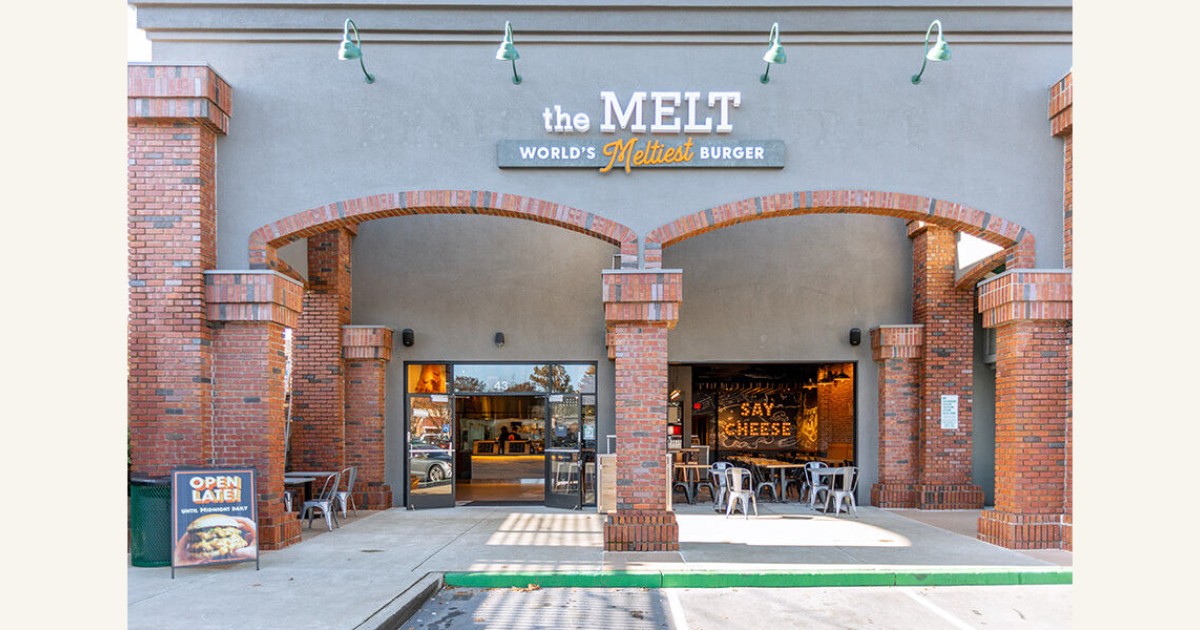
The Melt has crossed a consequential line in its growth plan: the 24-unit fast-casual burger chain has signed its first franchise development agreement, an eight-restaurant deal for Dallas-Fort Worth and Austin.
The company announced the agreement November 13 with Syed Ahmad, a veteran multi-brand operator whose career has included Jack in the Box, Burger King, Denny's, Dunkin' and Popeyes restaurants. The release does not identify opening dates, individual sites or how the eight units will be divided between the two Texas markets. Those details remain unverified and should not be inferred from the development commitment.
The importance is not simply eight more restaurants. The Melt says all 24 of its current restaurants are company-owned. Its first signed franchisee therefore becomes the initial outside operator asked to reproduce systems the company spent about 15 years testing in its own stores.
From a company chain to a mixed system
The Melt launched national franchising in April after operating more than 20 company restaurants. At the time, it said restaurants open longer than a year averaged $3.4 million in annual sales in 2025, while the top third exceeded $4.5 million. Those figures were company-reported and are not guarantees for the Texas restaurants.
The November agreement provides a clearer signal than earlier market-target announcements. The brand previously identified markets such as Florida as franchise opportunities; it now has a named franchise partner and a defined eight-unit territory covering two of Texas' largest metropolitan areas.
Ahmad's operating background is a central part of the selection. The Melt says he has more than 40 years in restaurants and has owned or operated 90 Burger King restaurants, 64 Denny's locations, three Dunkin' shops and 11 Popeyes restaurants during his career. The company also says he currently operates Popeyes restaurants and is opening Dunkin' and Jimmy John's locations in Texas, Oregon and Washington.
Those counts describe Ahmad's historical portfolio, not the size of a single current company. The current agreement is for eight The Melt restaurants.
What the deal does—and does not—prove
Development agreements can create a pipeline, but they are not the same as open restaurants. Real estate, permitting, construction, staffing and local demand will determine when and whether each committed unit reaches operation. The Melt did not publish a development schedule, investment amount or first-site address.
The brand's task is also different now. In a company-owned system, leadership can adjust menu, labor and kitchen practices directly. A franchise system must turn those practices into standards, training and field support that an outside organization can execute while carrying its own capital and local operating risk.
The Melt says its model uses compact footprints and a streamlined kitchen. Its April franchise launch described typical restaurants of roughly 1,900 to 2,300 square feet using two clamshell grills, two fryers, two impingement ovens, a shake machine and standardized preparation. The Texas deal will be the first public test of whether that operating package transfers to a franchise partner at multi-unit scale.
The geography adds another test. The Melt was founded in San Francisco and has built its company footprint primarily in California and Arizona. Dallas-Fort Worth and Austin will put the concept into large, competitive Texas burger markets while distancing the first franchise group from the core company estate.
The Braisepoint read
This is a milestone deal, not an opening announcement. The verified facts are the partner, the two Texas markets and the eight-unit commitment. The useful next disclosures will be a first lease, a development timetable and how The Melt supports a franchise group outside its company-store base.
If the eight restaurants open and perform, the agreement can become a template for the small group of experienced multi-unit operators The Melt says it wants. Until then, the real shift is structural: a company-owned chain has made its first franchise commitment, and Texas will be the proving ground.