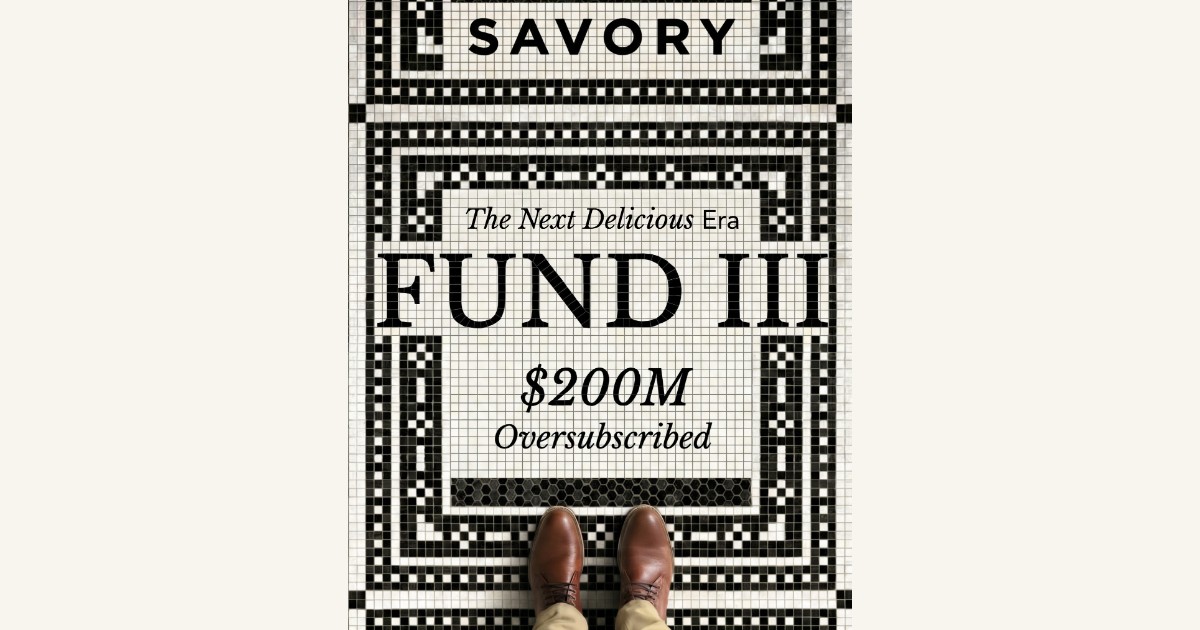
Savory Fund has closed its third restaurant investment vehicle at $201.5 million, slightly above its $200 million target, and says it has already deployed 35% of the capital across four emerging brands.
The October 13 announcement is useful less as a fundraising headline than as a map of where this restaurant-focused investor intends to place its next checks. Savory says Fund III will ultimately hold eight to nine portfolio companies, leaving four or five investments still to be made.
The four current Fund III brands are South Block, a Washington-area smoothie and acai concept; Bonrue Bakery, a Utah-based European-style patisserie; Hawkers Asian Street Food; and Zao Asian Grill. Savory describes all four as founder-led growth businesses and says the new fund will continue targeting profitable concepts across quick service, fast casual and casual dining.
That profitability requirement matters. The fund is not being framed as rescue capital for distressed chains or as a broad bet on restaurant traffic. Savory is looking for businesses that have already demonstrated a workable restaurant model but need capital and operating infrastructure to scale.
The firm pairs its investment dollars with a platform led by CEO Clay Dover. In its announcement, Savory emphasized operators, playbooks, revenue growth, profitability work and new-location development. For founders considering outside capital, that means the pitch is not only a larger balance sheet. It is a centralized operating system intended to address the functions that often become harder as a concept moves beyond its home market.
Savory says it now manages more than $750 million and has investments in 13 restaurant brands spanning more than 400 locations in 27 states. Those network figures are approximate company descriptions, so Braisepoint is not recording them as exact unit counts in the intelligence block.
The firm points to Swig and Mo’ Bettahs as evidence for the strategy. Savory says Swig expanded from 17 locations to 46 before it sold a majority stake to The Larry H. Miller Company in 2022. Mo’ Bettahs grew from six to 56 locations before a 2024 majority-stake sale to Blue Marlin Partners and Trive Capital. Savory remains a minority owner in both businesses, according to the announcement.
Past growth does not guarantee that Fund III’s current brands will follow the same path. The release does not disclose purchase prices, ownership percentages, valuations, individual investment amounts or expected holding periods for the four portfolio companies. It also does not identify the next acquisition target.
What it does disclose is the shape of the buying mandate. Savory wants another four or five profitable, founder-involved restaurant concepts, and it has a completed $201.5 million fund to pursue them. That creates a practical watchlist for restaurant operators: concepts with strong unit economics, a distinct category position and founders willing to remain involved are the likely targets.
The broader restaurant-finance signal is that institutional money remains available, but it is selective. In a market where weak traffic and expensive development can punish undisciplined expansion, Savory is explicitly selling operating capability alongside capital. The next measure of Fund III will not be the headline size of the fund. It will be whether its remaining investments can add units without weakening sales, margins or the founder-led identity that made the concepts attractive in the first place.