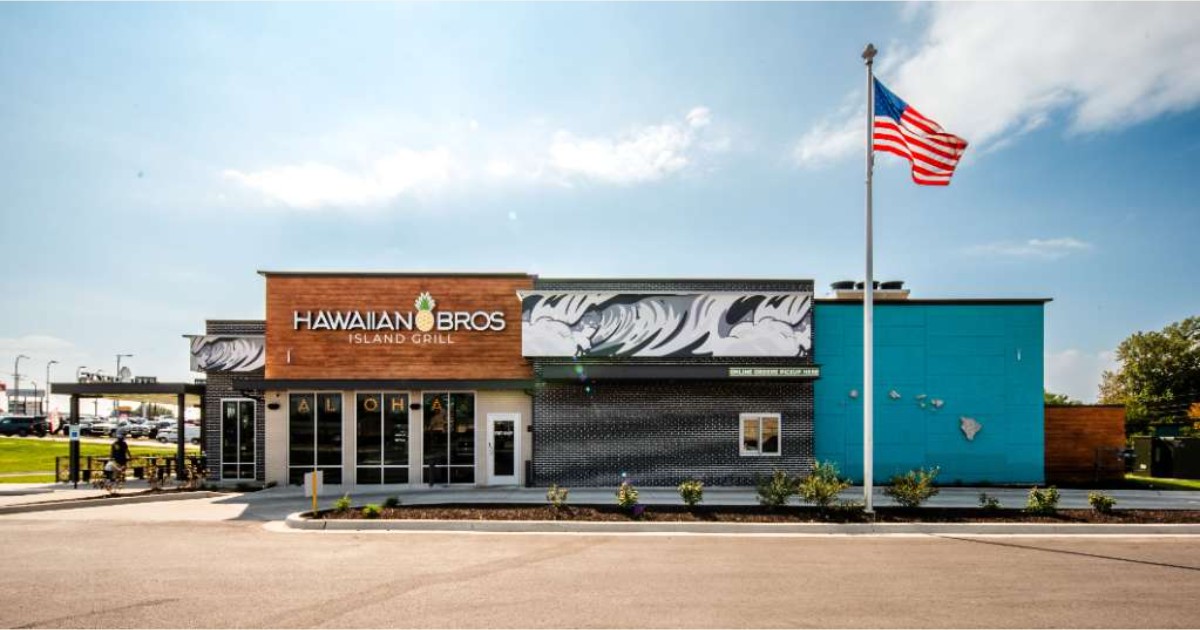
Hawaiian Bros Island Grill has signed a 52-unit Florida development agreement with Southern Rock Restaurants, one of the largest commitments in the chain’s franchise pipeline. The deal covers Jacksonville, Gainesville, Tampa and Orlando and calls for all 52 restaurants to be developed over six years.
The first phase is unusually front-loaded. Southern Rock plans 24 restaurants in the first three years—equal to roughly 30% of Hawaiian Bros’ current base of more than 80 open restaurants. That comparison is Braisepoint’s calculation from the company’s disclosed figures, not a forecast of system sales or opening completion.
No individual addresses or opening dates were announced. The agreement defines market rights and a development schedule; it does not mean 52 operating restaurants exist today. Exact sites will still require selection, approvals, construction and staffing.
Southern Rock brings a much larger operating platform than the brand it is joining. Led by CEO Max Piet, the group owns and operates nearly 200 McAlister’s Deli and Dave’s Hot Chicken restaurants across 13 states, according to Hawaiian Bros. Piet has more than 35 years of restaurant experience and a track record in multiunit fast casual development.
That experience is central to the deal’s risk profile. Hawaiian Bros is entering a new state across four geographically distinct Florida markets, and the six-year schedule will require local real estate, construction and field-leadership capacity. An operator already managing close to 200 units can supply infrastructure that a smaller, single-brand franchisee would have to build.
For Hawaiian Bros, the agreement is less about adding one market than about increasing its development pipeline in a single transaction. The company says it has more than 350 restaurants under development agreements across 20 states and more than 75 markets with 13 multiunit franchisees. The brand currently operates more than 80 restaurants across 14 states, with a majority franchisee-owned.
The numbers also show the widening gap between open units and contracted growth. If every development agreement were completed, the pipeline alone would be more than four times the current open-store base. That ratio is Braisepoint’s calculation from company disclosures; development agreements are commitments, not a guarantee that every restaurant will open on the original timetable.
Hawaiian Bros is pitching operational simplicity as part of its franchise case. Its restaurants use a focused plate-lunch menu and, according to the company, operate without freezers, fryers or microwaves. A narrow production system can support consistency, but the Florida commitment will still test how quickly the brand can transfer training and culture across four new metropolitan areas.
The deal is also a portfolio decision for Southern Rock. The operator already has scale in McAlister’s Deli and Dave’s Hot Chicken; Hawaiian Bros adds another fast-casual growth vehicle without starting from a single-unit platform. For brand owners, that makes Southern Rock’s allocation of people, real estate and capital across concepts worth watching.
The immediate milestone is not the full 52-unit total. It is the 24-unit first phase. Reaching that target would require an average of eight openings a year for three years, although the company did not publish an annual cadence or specify which Florida market goes first.
Until addresses or dates are released, readers should treat Jacksonville, Gainesville, Tampa and Orlando as development territories rather than confirmed store locations. The agreement is material because of its scale, but execution will be visible one lease and one opening at a time.