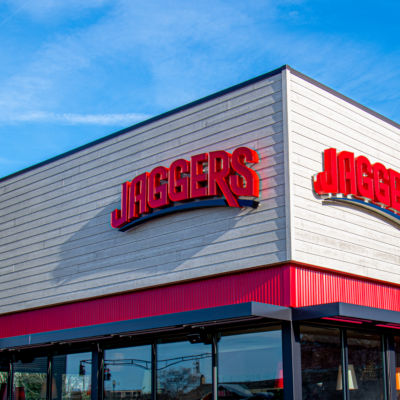
Jaggers is not expanding across the country in a straight line. It is building outward from home.
The fast-casual brand created by Texas Roadhouse founder Kent Taylor has 17 open U.S. restaurants, according to a review of Jaggers' current ordering system. Eleven of those locations are in Kentucky or Indiana.
That concentration matters more than the raw store count.
Jaggers has six open Indiana restaurants, including locations in Jeffersonville and Columbus as well as four in the Indianapolis area. Kentucky has five: three in Louisville and two in Lexington. Together, the two states account for nearly two-thirds of Jaggers' domestic footprint.
The next wave appears likely to deepen that cluster. Jaggers' ordering system lists upcoming Kentucky restaurants in Frankfort, Florence and Louisville's Fern Creek area. The company has posted an October 12 opening date for Frankfort. It has not posted opening dates for Florence or Fern Creek, so those projects should be treated as developing locations rather than completed openings.
The Florence project offers a closer look at the format. Boone County planning documents described a proposed 3,500-square-foot restaurant with 93 indoor seats and two drive-thru lanes. The location would sit near an existing Texas Roadhouse on Houston Road, creating a physical link between the parent company's established casual-dining brand and its smaller fast-casual concept.
Jaggers' menu is built around burgers, hand-breaded chicken tenders and sandwiches, salads and milkshakes. Its combination of drive-thru, carryout, delivery and dine-in service gives Texas Roadhouse a way to compete for occasions that do not naturally fit a steakhouse.
The expansion is still modest inside a company with more than 830 restaurants across its concepts. But Jaggers is moving.
Texas Roadhouse reported 18 Jaggers restaurants systemwide at June 30: 11 company-owned, six domestic franchises and one international franchise. That was up from 15 a year earlier. The company opened one company Jaggers and one domestic franchise Jaggers during the first half of 2026.
Management has not broken out Jaggers sales, traffic or restaurant-level profitability. It would therefore be premature to describe the concept as a proven national growth engine. A 20% increase in a small unit base can be meaningful without resolving the larger question of how the brand performs outside its strongest markets.
What the map does show is a disciplined way to learn.
Adding restaurants near Louisville, Southern Indiana and the broader Kentucky market can give Jaggers operating density before it makes a more expensive national push. Nearby stores can share brand awareness, management experience, vendors and local knowledge. They can also make it easier to compare site types and refine drive-thru execution without spreading a young system too thin.
That regional strategy is an inference from the location pattern, not a growth plan Texas Roadhouse has formally named. But the pattern is difficult to miss: Kentucky and Indiana are not just part of the Jaggers footprint. They are the center of it.
The approach also creates a useful test for the parent company. Texas Roadhouse knows how to build destination restaurants around dinner, hospitality and large dining rooms. Jaggers asks a different question: can the same organization create a repeatable fast-casual business where speed, convenience and drive-thru throughput matter as much as the dining-room experience?
What changed is the density. Jaggers has grown from 15 to 18 restaurants systemwide in a year, while its own customer-facing system points to three additional Kentucky sites.
Why it matters is that Texas Roadhouse is developing a second kind of growth platform close to its Louisville base—one designed for smaller checks, quicker visits and more frequent convenience occasions.
What happens next will be visible on the ground. Watch whether Frankfort opens on schedule, whether Florence and Fern Creek advance to opening dates, and whether Jaggers uses the lessons from Kentucky and Indiana to enter new markets with the same operating discipline.
Jaggers does not yet have to be everywhere to matter. First, it has to prove that being concentrated makes it stronger.