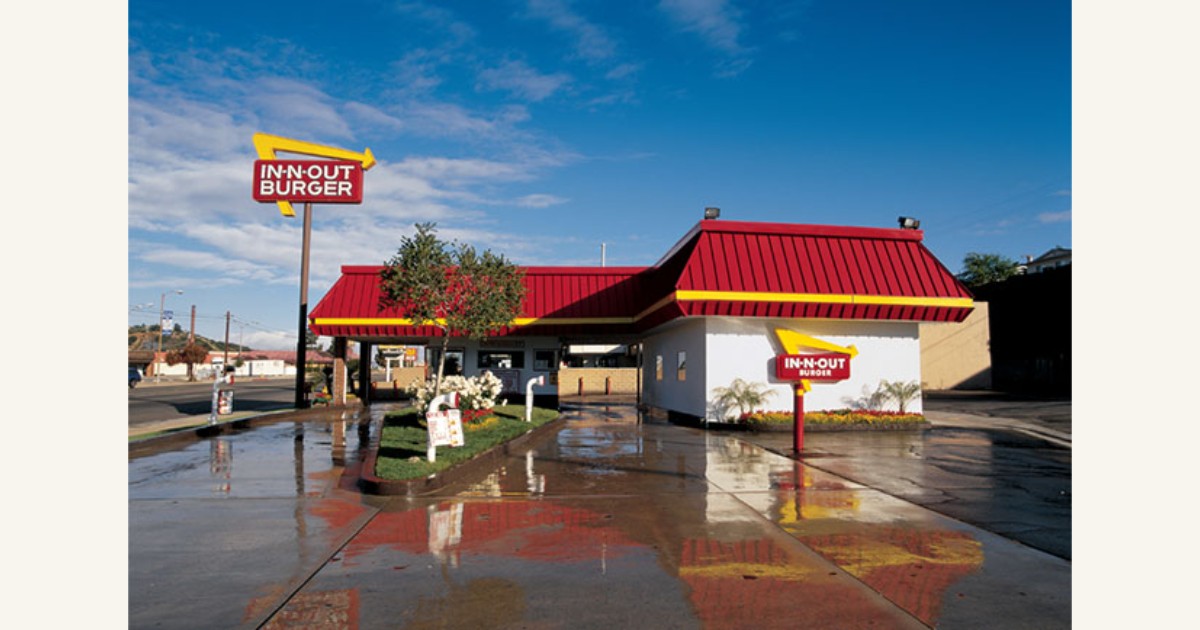
In-N-Out Burger opened a new Stockton, California, restaurant October 9 with approximately 60 employees and a $22 hourly starting wage, giving restaurant operators an unusually specific snapshot of the labor and format behind one unit of the privately held chain.
The restaurant is at 10537 Trinity Parkway and is managed by Juan Rosa, a 14-year In-N-Out veteran. The company says hiring will continue in the months after opening.
The physical layout combines one drive-thru lane with 84 indoor seats and 48 covered patio seats. That is 132 seats in all, making this more than a drive-thru-only build even though the lane remains central to the brand. Regular hours are 10:30 a.m. to 1 a.m. daily, extending to 1:30 a.m. Friday and Saturday.
For the labor beat, the useful number is not just the starting wage. In-N-Out is staffing the opening with about 60 associates while naming a manager who has spent 14 years inside the system. The pairing illustrates the chain’s long-standing preference for internal development and company control instead of handing restaurant operations to franchisees.
In-N-Out says none of its restaurants are franchised. The Snyder family still owns and operates the business, and the company supplies its stores from its own network. In its Stockton announcement, it said hamburger patties are produced by its own butchers, delivered fresh through the week and never frozen; produce is prepared daily in the restaurants; and fries are cut from whole potatoes.
That supply model helps explain why In-N-Out expands more deliberately than chains built to sell franchises quickly. The company’s media kit says new stores must remain within a single day’s truck drive of one of its in-house patty-making facilities. Stockton is therefore not just another dot on a national map; it is a unit added inside a controlled supply radius.
The company now lists restaurants in California, Nevada, Arizona, Utah, Texas, Oregon, Colorado, Idaho, Washington and Tennessee, with New Mexico in development. It describes more than 400 locations and more than 44,000 associates in its current corporate history. The Stockton release did not provide an exact companywide unit count, so Braisepoint is not converting ‘more than 400’ into a precise intelligence field.
The format is also worth watching. One drive-thru lane can look small beside the multilaned builds now common in quick service, but the Stockton unit is paired with a sizable dining room and patio. That spreads demand across car, dining-room and outdoor occasions while keeping the chain’s familiar late-night hours.
At the stated opening staffing level, the unit’s $22 starting wage is a visible commitment before payroll taxes, benefits or higher-paid positions are counted. The release does not say how many of the roughly 60 jobs are full time, how many hours each associate will receive or what the full compensation package costs. Those unknowns matter, so the announcement should not be used to calculate annual payroll.
What can be said is concrete: In-N-Out disclosed the headcount, base starting wage, management tenure, seating mix and operating hours for the same restaurant. Few chain opening announcements give operators that complete a picture.
The Stockton opening reinforces a distinctive growth equation: company ownership, tightly bounded distribution, internal leadership development and above-minimum-market wages all move together. That approach can slow geographic expansion, but it also keeps the restaurant, supply chain and employment model under one owner’s control.